English Languages
71,8 thousands Population
XCD Currency
3,5% (2024) GDP
Employment by Major Industries
28Service sector
32Industry
40Agriculture
Country profile
Overview
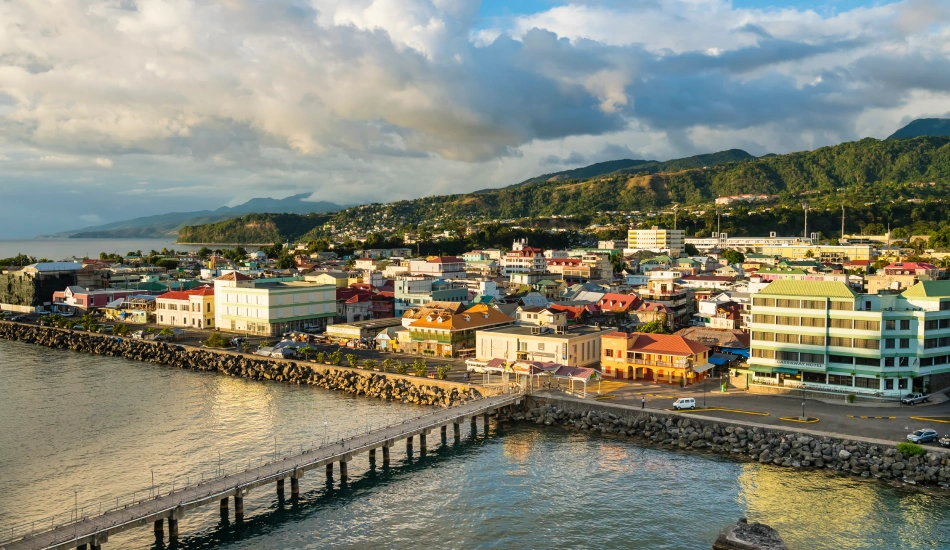
Dominica is an island country of the Lesser Antilles in the eastern Caribbean Sea. The official name of the territory is the Commonwealth of Dominica. It lies between the French islands of Guadeloupe and Marie-Galante to the north and Martinique to the south.
The country has been a member of the Commonwealth since independence in 1978. The island covers an area of 751 square kilometres and has a population of approximately 71,808 people. The capital and chief port is Roseau.
Dominica, known as the “Nature Island of the Caribbean,” was originally inhabited by the Kalinago people. Christopher Columbus encountered the island on November 3, 1493, naming it after the day of the week, Sunday. Despite European interest, Dominica remained largely under the control of the Kalinago due to its rugged terrain and fierce resistance. In the 17th and 18th centuries, France and Britain vied for control, with Britain ultimately gaining sovereignty in 1763 through the Treaty of Paris. The island was used for plantation agriculture during the colonial era, relying heavily on enslaved Africans for labor. Slavery was abolished in 1834, leading to significant demographic changes and the development of a predominantly Afro-Caribbean culture. In 1967, Dominica became an associated state of the United Kingdom, gaining full control over its internal affairs. On November 3, 1978, it achieved independence as the Commonwealth of Dominica, becoming a republic within the British Commonwealth. Post-independence, the country faced challenges such as political instability and natural disasters, including frequent hurricanes due to its location. Despite these challenges, Dominica has focused on eco-tourism and preserving its natural environment, boasting pristine rainforests and the world-famous Boiling Lake. The island’s cultural heritage blends African, French, and British influences, reflected in its Creole language and annual World Creole Music Festival. Today, Dominica is celebrated for its commitment to sustainability, aiming to become the world’s first climate-resilient nation.
Real GDP growth for 2023 – 4.7% and 3,5% for 2024
(https://www.imf.org/external/datamapper/NGDP_RPCH@WEO/DMA?zoom=DMA&highlight=DMA)
Country Calling Code: +1-767
Official languages
The national and official language of Dominica is English; however, French and a local French Creole dialect are widely spoken.
Currency
Dominica’s currency is the East Caribbean Dollar (symbol: EC$; code: XCD).
Political System
The political system of Dominica is a parliamentary democracy within the framework of a republic, rooted in the principles of the British Westminster system. The President serves as the head of state, elected by the House of Assembly, and performs largely ceremonial functions. Executive power lies with the Prime Minister, who is the head of government, and the Cabinet, responsible for policy-making and administration.
The unicameral House of Assembly comprises 21 elected representatives, known as Members of Parliament, and 9 appointed Senators, some chosen by the President on the Prime Minister’s advice and others on the Leader of the Opposition’s advice. General elections are held every five years, with a simple majority system determining parliamentary representation. Local government is administered through ten parishes, each represented by councils responsible for community development. Dominica has a vibrant multiparty system, with the Dominica Labour Party and the United Workers Party being the dominant political entities. The constitution guarantees fundamental rights and freedoms, including freedom of speech, religion, and assembly. Internationally, Dominica is an active member of organizations such as the Commonwealth, the Caribbean Community (CARICOM), and the Organization of Eastern Caribbean States (OECS), reflecting its commitment to regional and global cooperation.
Legal System
The legal system of Dominica is based on English common law, reflecting its history as a former British colony. The supreme law of the land is the Constitution, which guarantees fundamental rights and freedoms to its citizens.
The judiciary operates independently, with the Eastern Caribbean Supreme Court serving as the apex court for the region, overseeing constitutional and appellate matters for Dominica. Below this, the Magistrates’ Courts handle minor criminal cases, civil disputes, and preliminary hearings for serious offenses. The President appoints judges on the advice of the Judicial and Legal Services Commission, ensuring impartiality and adherence to the rule of law. Dominica’s legal framework incorporates statutes enacted by its Parliament, alongside principles of common law and equity. The Attorney General is a key legal officer, providing guidance to the government on legal matters. Dominica is also a member of regional and international legal organizations, ensuring its laws align with global standards and commitments, particularly in areas such as human rights and trade agreements.
Options of Doing Business in Spain for a foreign entity expanding abroad
Company
Subsidiary
Joint Venture
Partnership
Independent Contractor
GEOR
Foreign companies looking to expand their business in Dominica have several business vehicles to choose from, depending on their operational needs, tax planning, and the level of liability protection they seek. The main business vehicles available for foreign companies in Dominica include:
- Limited Liability Companies (LLCs): LLCs provide flexibility by combining partnership and corporate features. They offer limited liability for members, pass-through taxation to avoid double taxation, and adaptable governance. LLCs are particularly favoured for small to medium-sized businesses and joint ventures.
- Corporations: Corporations available as public or private entities, are separate legal entities with limited liability for shareholders. They allow raising capital through share issuance and are suited for large-scale operations, including manufacturing and trade. These entities require filing of Memorandum and Articles of Association and regular regulatory compliance.
- Joint Ventures (JVs): JVs are collaborative projects between local and foreign entities, often used for large-scale or high-risk projects like tourism or renewable energy development. These ventures combine resources and expertise to achieve specific goals.
- Partnerships: Partnerships include general and limited partnerships. General partnerships involve shared liability, while limited partnerships restrict liability to the partner’s contribution. They are suitable for collaborative ventures and require registration with the CIPO.
- Subsidiary: The most popular types of subsidiaries for foreign investors in Dominica include Limited Liability Companies and Corporations.
- Branch Offices allow foreign companies to extend their operations into Dominica without creating a separate legal entity. The parent company bears liability for the branch, which is often used to test local markets or facilitate regional operations.
- Representative Office: In Dominica, representative offices are an option for foreign investors seeking to establish a non-commercial presence in the country. These offices are typically used for market research, liaison activities, or promoting the parent company’s interests without engaging in direct revenue-generating operations.
- Sole Proprietor and Independent Contractor: Sole Proprietorships are the simplest form of business ownership, operated by a single individual with personal liability for business debts. They are typically used for small, local businesses and require basic registration with the Companies and Intellectual Property Office (CIPO).
- GEOR (Global Employer of Record) – a B2B service provider that acts as the legal employer of workers on behalf of a business worldwide.
The setup and dissolution of companies for foreign investors in Dominica are governed by several key legislative acts. These acts outline the legal framework for registering, operating, and winding up businesses in the jurisdiction. Below are the most relevant statutes:
The incorporation and dissolution of companies by foreign investors in Dominica are primarily regulated by the following key legislative acts:
- Companies Act, 1994: This act provides the framework for the incorporation, operation, and dissolution of companies in Dominica. It includes provisions on the registration process, governance structures, filing requirements, and criteria for winding up a company. It governs both domestic and foreign companies operating in the jurisdiction
- Insolvency Act, 2013: This act governs the process of liquidating companies, including those owned by foreign investors, in cases of insolvency. It provides procedures for creditors, the distribution of assets, and the appointment of liquidators
- Foreign Investment Act: Although not specifically for incorporation or dissolution, this act outlines the rights and responsibilities of foreign investors, including compliance with local regulations and provisions for exiting investments.
Government services portal: https://www.dominica.gov.dm
Limited Liability Company (LLC)
Setting Up a Limited Liability Company (LLC)
The process for setting up a Limited Liability Company (LLC) in Dominica for foreign investors involves several structured steps:
- Choose a company name that includes “Limited Liability Company” or “LLC” and ensure it is distinct from existing companies.
- Appoint a registered agent located in Dominica to serve as the official contact point for the company.
- Prepare necessary documents, including the Articles of Organization outlining the company’s purpose, structure, and management, and an Operating Agreement detailing the rights and responsibilities of members. If any members are corporations, a Certificate of Good Standing may also be required.
- File the incorporation documents with the Dominica Companies and Intellectual Property Office (CIPO).
- Pay the required government fees upon filing the incorporation documents.
- Obtain a Tax Identification Number (TIN) from the Inland Revenue Division to fulfill tax registration requirements.
- Open a corporate bank account in Dominica to facilitate financial operations and comply with local banking regulations.
Costs
Government fees can range from a few hundred to a few thousand EUR, depending on the specific services required. The annual fee for a registered agent typically ranges from EUR 500 to EUR 1,000.
Timelines
The entire process typically takes 2 to 4 weeks, contingent on the completeness of the application and the efficiency of the approval process.
Closing a Limited Liability Company (LLC)
The process of closing a Limited Liability Company (LLC) in Dominica for a foreign investor involves several key steps to ensure the company is legally dissolved. These steps include:
- Approval for Dissolution: The LLC must pass a resolution from the members or shareholders approving the dissolution. This resolution is necessary to begin the process of winding down operations.
- Settle Outstanding Obligations: The LLC must settle any outstanding debts, including tax obligations, liabilities to creditors, and payments to employees. This includes paying any overdue fees to the Inland Revenue Division and other relevant authorities.
- Prepare and Submit Dissolution Documents: The company must prepare the necessary dissolution documents, which include the Resolution of Dissolution, financial statements showing the company’s final financial position, and a Declaration from the directors confirming that the company has no outstanding debts.
- Notify Relevant Authorities: After the dissolution resolution, the LLC must inform the relevant authorities, such as the Companies and Intellectual Property Office (CIPO), and submit the dissolution documents. The company must also notify the tax authorities, as well as any other regulatory bodies relevant to its business operations.
- Close Bank Accounts: The company should close its corporate bank accounts after ensuring all transactions are cleared and any remaining funds are properly allocated.
- Publication of Dissolution: In some cases, the company may need to publish a notice of its dissolution in a local newspaper to inform the public and stakeholders about the closure.
- Receive Certificate of Dissolution: Once all documents are submitted and approved by CIPO, the company will receive a Certificate of Dissolution, officially marking the end of its legal existence.
Costs
The cost of closing a Limited Liability Company (LLC) in Dominica for a foreign investor varies based on the complexity of the company’s operations and the required services during the dissolution process. Generally, the costs involved can range from EUR 300 to EUR 1,500. These fees typically cover the dissolution procedure, including legal and administrative services such as preparing dissolution documents, notifying authorities, and completing any necessary filings with the Companies and Intellectual Property Office.
Timelines
The entire process typically takes 1 to 2 months, depending on the complexity of the company’s financial situation and the efficiency of the authorities involved. If there are no assets or debts, the process may be completed faster.
Corporation
Setting Up a Corporation
In Dominica, a Corporation refers to a company formed as a separate legal entity distinct from its owners (shareholders). This structure provides limited liability protection, meaning shareholders are not personally responsible for the corporation’s debts or obligations beyond their investments. A corporation can own property, enter contracts, and conduct business in its own name. Shareholders’ liability is limited to their share capital, protecting personal assets. Corporations typically have a board of directors overseeing management and shareholders who own the company. A Corporation can be structured as either a private corporation, limiting share transfers, or a public corporation, which can raise funds through share offerings. Governed by the Companies Act, 1994, which defines incorporation, operation, and dissolution procedures. It is commonly chosen for large-scale businesses, those requiring significant capital, or companies operating in highly regulated industries. Corporations in Dominica are a popular choice for both local and foreign investors due to their robust legal protections and flexibility in structuring business operations.
Setting up a corporation in Dominica for foreign investors involves the following steps:
Choose a Corporate Name: The foreign investor must select a unique name for the corporation, ensuring it complies with naming regulations under the Companies Act, 1994. The name must include designations like “Limited,” “Corporation,” or “Incorporated” (or their abbreviations) and should not conflict with existing registered names.
Appoint Directors and Shareholders: At least one director and one shareholder are required. Directors can be individuals or corporate entities of any nationality. Shareholders hold ownership in the company, and their information must be documented.
Prepare Incorporation Documents: The investor must prepare the Memorandum and Articles of Association, outlining the company’s objectives, structure, and rules of governance. Additional documentation may include declarations of compliance and identification of company officers.
File Incorporation Application: Submit the incorporation documents to the Dominica Companies and Intellectual Property Office (CIPO). The application includes:
- Articles of Incorporation
- A statutory declaration by a registered agent
- The proposed business name and corporate details
Pay Registration Fees: Government fees for incorporating a corporation range from USD 750 to USD 2,000 (approximately EUR 700 to EUR 1,800), depending on the share capital and any expedited services required.
Obtain a Taxpayer Identification Number (TIN): Upon incorporation, the corporation must register with the Inland Revenue Division to obtain a TIN and comply with tax regulations. If applicable, registration for Value Added Tax (VAT) is also required.
Open a Corporate Bank Account: The corporation must open a local or international bank account to facilitate financial transactions. Banks will typically require the Certificate of Incorporation and other corporate documents.
Secure Necessary Licenses and Permits: Depending on the nature of the business, specific licenses or permits may be required from relevant government agencies or ministries.
Costs
Setting up a corporation in Dominica for foreign investors involves several statutory costs and requirements. The costs typically include:
- Incorporation Fees: Registering an International Business Company (IBC) in Dominica can cost between €750 and €1,500, depending on the type of company and specific services required. This includes registration and government fees for the Certificate of Incorporation.
- Registered Agent and Office Fees: It is mandatory to appoint a registered agent and maintain a registered office in Dominica. Annual fees for these services range from €250 to €500.
- Legal and Professional Fees: Legal assistance and consultancy for document preparation and compliance can cost €500 to €1,000 or more, depending on the complexity of the business setup.
- Bank Account Setup: Opening a business bank account may require a minimum deposit and incur additional fees for remote processing if needed.
Timelines
The process typically takes 2 to 4 weeks, depending on the completeness of the application and responsiveness of the authorities.
Closing a Corporation
The process of closing a corporation in Dominica, often referred to as corporate dissolution, involves several steps to ensure compliance with local laws. Below is an outline of the general procedure:
- Board and Shareholder Approval: The process typically begins with a resolution by the corporation’s board of directors, followed by approval from the shareholders, as stipulated in the company’s bylaws and the Companies Act of Dominica.
- Notification to Authorities: The company must formally notify the Registrar of Companies about its intention to dissolve. This includes filing a notice of intent and providing supporting documentation such as a shareholder resolution.
- Settling Debts and Liabilities: Before dissolution, the company must settle all outstanding liabilities, including debts to creditors, employees, and tax obligations. This step ensures that the company is clear of financial obligations.
- Liquidation of Assets: The corporation’s remaining assets are liquidated and distributed among shareholders according to their ownership stakes after debts are cleared.
- Filing Final Returns: The company must file its final tax returns with the Dominica Inland Revenue Division, addressing all tax obligations, including income tax and value-added tax (VAT), if applicable.
- Official Deregistration: A formal application for deregistration must be submitted to the Registrar of Companies. Upon review and approval, the Registrar issues a certificate of dissolution, marking the company as officially closed.
- Record Retention: The company’s directors or designated representatives should retain important records, such as financial and legal documents, for a prescribed period as required by Dominica’s laws.
Costs
The costs and timelines for closing a corporation in Dominica for foreign investors depend on several factors, such as the type of corporation, outstanding obligations, and legal or professional assistance required. Below is a general breakdown:
- Filing fees for notifying the Registrar of Companies about the dissolution typically range from €300 to €500.
- Legal or accounting services are often required to ensure compliance with corporate and tax laws. These services may cost between €500 and €2,000, depending on the complexity of the dissolution and the firm engaged.
- Costs for obtaining tax clearance, including final tax return preparation, may vary but generally range from €300 to €1,000.
- If the company undergoes a formal liquidation process, additional fees for liquidation agents or professionals may range from €1,000 to €5,000.
- Miscellaneous expenses, such as notarization, courier services, and asset valuation, could add €200 to €500.
Timelines
In total, the process may take 4–12 months, depending on the company’s situation and whether legal issues or disputes arise.
A Subsidiary, a Branch and a Representative office
A Subsidiary
Setting Up a Subsidiary
The most popular types of subsidiaries for foreign investors in Dominica include the following:
- Limited Liability Companies (LLCs): LLCs provide a blend of flexibility and protection by combining limited liability for members with pass-through taxation. They are favored for small to medium-sized businesses and joint ventures due to their ease of management and operational advantages.
- Corporations: Foreign investors often opt for corporations (public or private) when aiming for large-scale operations. Corporations allow for the raising of capital through share issuance and provide limited liability protection to shareholders. They are governed by Dominica’s robust corporate legal framework, which ensures accountability and stability.
Please refer to the relevant parts of the text for the details of incorporating and dissolving, costs and timelines associated.
A Branch
Setting up a Branch
To establish a branch of a foreign company in Dominica, a foreign investor must follow the outlined steps, ensuring compliance with local legal and administrative requirements:
Obtain Authorization: Foreign companies can set up branches as permitted under Dominica’s Companies Act. The investor must submit the intended scope of the branch’s operations to the Companies and Intellectual Property Office (CIPO).
Appoint a Local Representative: Each branch must designate at least one local representative with full power of attorney to manage the branch’s operations in Dominica. This is essential for regulatory compliance and effective local management.
Prepare Necessary Documentation: Documents typically include (These documents may need to be notarized and, in some cases, legalized or apostilled.):
- Certificate of incorporation of the parent company.
- Articles of association or memorandum of the parent company.
- A resolution from the parent company authorizing the establishment of the branch.
- Copies of passports and identification for directors/shareholders.
Register the Branch: Submit the application for branch registration with CIPO. This includes providing all required documents, registering the business name, and detailing the branch’s operations.
Obtain Licenses and Permits: Depending on the branch’s activities, specific licenses or permits might be required. For instance, businesses in regulated sectors (e.g., finance, insurance) need additional approvals.
Tax Registration: The branch must register with the Inland Revenue Division to obtain a Taxpayer Identification Number (TIN) and comply with applicable tax regulations.
Open a Bank Account: Set up a corporate bank account to facilitate local financial transactions.
Comply with Employment Laws (if applicable): If the branch hires employees locally, it must register for social security contributions and comply with labor regulations.
Costs
Fees vary but include registration costs, legal fees for document preparation, and other administrative expenses. These may range from approximately €2,500 to €5,000, depending on complexity and additional services such as obtaining permits or hiring legal representatives
Timelines
The process typically takes 4–6 weeks, depending on the completeness of the application and the responsiveness of local authorities.
Closing a Branch
Closing a branch in Dominica for a foreign company involves several steps to ensure compliance with local legal and regulatory requirements:
Resolution by the Parent Company: The parent company must issue a formal resolution to close the branch in Dominica. This document should outline the decision and specify the closure timeline.
Notification to Authorities:
- Registrar of Companies: The branch must file a notice of closure with the Companies and Intellectual Property Office (CIPO). This typically involves submitting deregistration forms and providing documentation, such as the original branch registration certificate.
- Tax and Financial Authorities: Inform the Inland Revenue Division (IRD) to settle any outstanding taxes and close the branch’s tax accounts. This includes submitting final tax returns and clearing any liabilities.
- Social Security: If the branch had employees, the Social Security Board must be notified to address contributions and close employer accounts.
Settlement of Debts and Liabilities: The branch must settle any outstanding debts, employee obligations, or contracts. It may also need to publish a notice of closure to notify creditors and other stakeholders.
Asset Disposal: If the branch owns local assets, these must be liquidated or transferred. The process must comply with Dominica’s laws, including applicable taxes or permissions.
Closure Audit: An audit may be required to verify that all financial and legal obligations have been met.
Final Deregistration: Once all obligations are cleared, the branch can be formally removed from the business register. This step often requires confirmation letters from relevant authorities (tax, social security, etc.) to ensure no liabilities remain.
Costs
Filing fees with the Companies and Intellectual Property Office (CIPO) are approximately €180–€450, depending on the scope of the deregistration process
Professional fees for tax compliance and obtaining a clearance certificate are around €450–€900, depending on the complexity of the branch’s operations and tax obligations.
Legal fees for preparing deregistration forms, notices, and other documentation range from €900 to €2,000.
Accounting and audit fees for preparing final accounts and confirming financial compliance range from €900 to €1,800.
Timelines
The entire process may take 6–10 weeks, depending on the branch’s size, obligations, and potential complications.
A Representative office
Setting up a Representative office
The process of setting up a representative office in Dominica for a foreign company involves several key steps. A representative office is typically established for non-commercial activities, such as market research or acting as a liaison between the parent company and local businesses, without generating revenue.
- Determine the Scope of Activities: Clearly define the purpose and scope of the representative office, ensuring it aligns with the regulations in Dominica, as representative offices are not allowed to engage in profit-making activities.
- Appoint a Local Representative: The office must designate a local representative with the authority to manage its activities in Dominica. This individual is typically granted a power of attorney to handle administrative matters.
- Submit the Application: Prepare the required documentation, including the parent company’s registration documents, a resolution authorizing the establishment of the office, and a description of the intended activities. These documents should be submitted to the Companies and Intellectual Property Office (CIPO) in Dominica.
- Obtain Necessary Approvals: Once the application is reviewed and approved by the relevant authorities, the representative office is issued a registration certificate.
- Establish a Local Address: The office must have a physical address in Dominica, which serves as its official location for communication and documentation.
- Comply with Tax and Regulatory Requirements: Although a representative office is not engaged in commercial activities, it may still need to register with tax authorities and comply with other local regulations, such as social security registration for employees if applicable.
Costs
Costs may include government fees, professional service fees for local representation, and legal consultation fees. These costs vary widely but typically range between €1,000 and €3,000.
Timelines
The timeline for this process can vary but typically ranges from 2 to 6 weeks, depending on the completeness of documentation and the efficiency of local authorities.
Closing a Representative office
The process for closing a representative office in Dominica for a foreign company generally includes the following steps:
- Clear Outstanding Obligations: The representative office must settle all pending business activities, such as paying outstanding taxes, clearing any liabilities, and finalizing any ongoing contracts. A final tax clearance certificate should be obtained.
- File Deregistration Applications: Applications to close the office must be submitted to relevant regulatory authorities. This often involves presenting a board resolution to close the representative office, along with supporting documentation.
- Cancel Registrations and Licenses: The office must deregister with agencies like the Companies Registry, the Inland Revenue Division, and other applicable regulatory bodies. Any operational permits or licenses specific to the office must also be canceled.
- Close Bank Accounts: Any local bank accounts associated with the representative office must be closed. The legal representatives or authorized signatories will handle this by submitting the required closure documents to the bank.
- Document Submission and Finalization: After completing the above steps, the office must provide proof of compliance with all legal and tax requirements to obtain a formal notice of deregistration or closure from the government.
Costs
Costs for deregistration services vary but could range from €2,000 to €5,000, including professional fees, filing fees, and other administrative expenses.
Timelines
The timeline for closing a representative office in Dominica typically ranges from 3 to 6 months, depending on the complexity of the business operations and the responsiveness of authorities.
Joint Venture
Joint Venture (JV)
Setting Up a Joint Venture (JV)
Setting up a Joint Venture (JV) in Dominica for foreign investors involves several key steps, which aim to ensure compliance with local laws and regulations while facilitating successful collaboration. The process consists of the following stages:
- Choose the Type of Joint Venture: Foreign investors must first decide on the structure of the JV. A JV can take various forms, such as a partnership, a corporation, or a limited liability company (LLC). Each structure has distinct legal and tax implications, so it is crucial to choose the one that best suits the nature of the business and the level of risk management required.
- Conduct Due Diligence: Before establishing a JV, foreign investors should perform thorough due diligence. This includes researching potential local partners, assessing the market, understanding the legal landscape, and confirming the financial stability and reputation of any potential JV partner.
- Register the Business Entity: To formalize the JV, investors must register the business with the Dominica Financial Services Unit (FSU) and the Registrar of Companies. The registration process involves providing documentation such as the JV agreement, proof of identification, and incorporation documents. The company must also have a registered office in Dominica.
- Draft a Joint Venture Agreement: The JV partners should agree on a comprehensive Joint Venture Agreement. This agreement outlines the scope of the business, capital contributions, management structure, profit-sharing arrangements, and the exit strategy. The agreement must be in compliance with Dominica’s Companies Act and other applicable regulations.
- Obtain Necessary Licenses and Permits: Depending on the industry, foreign investors may need to apply for specific licenses or permits before commencing operations. For example, businesses involved in tourism, real estate, or agriculture may require additional permits from relevant government agencies. It is essential to check the specific licensing requirements for the type of business being pursued.
- Open a Bank Account: A business bank account must be opened in the name of the JV entity. This will allow for financial transactions, payment of taxes, and other operational activities. Foreign investors should select a bank that offers services for international businesses and is familiar with handling foreign investments.
- Hire Local Staff (if applicable): Depending on the nature of the JV, it may be necessary to hire local employees. Dominica has regulations related to work permits for foreign workers, and it may be necessary to submit applications for any foreign employees who will be involved in the JV. Local labor laws also need to be adhered to, including those related to employment contracts, wages, and benefits.
- Comply with Tax and Reporting Requirements: The JV must comply with Dominica’s tax regulations, including paying corporate income tax, VAT (if applicable), and other relevant taxes. Investors are required to submit regular tax returns and adhere to the financial reporting standards set by the Dominica Inland Revenue Division.
- Engage with Government Agencies: Throughout the setup process, it may be necessary to engage with government agencies such as the Dominica Investment Promotion Authority (DIPA). This agency helps facilitate investments in Dominica and may offer incentives, such as tax breaks, for certain types of foreign investment.
- Ongoing Compliance and Governance: Once the JV is operational, the partners must ensure compliance with ongoing regulatory requirements, such as annual filings, audits, and adherence to labor and environmental laws. It is also important to maintain open communication and resolve any potential disputes in accordance with the terms set forth in the JV agreement.
Costs
The registration fees for incorporating a business in Dominica typically range between EUR 500 to EUR 1,000, depending on the company structure (e.g., LLC or corporation).
Depending on the industry, licensing and permit costs can vary. For example, a tourism-related business may incur additional costs in the range of EUR 500 to EUR 2,000 for special permits. Agriculture or real estate businesses might also face varying fees.
Opening a business bank account in Dominica generally involves fees between EUR 100 to EUR 300 for the account setup and any initial deposit requirements.
Timelines
Registration can take approximately 5 to 7 business days. Obtaining licenses and permits can take 2 to 6 weeks, depending on the industry and the complexity of regulatory requirements. Setting up a business bank account usually takes 1 to 2 weeks once all documents are submitted.
Closing a Joint Venture (JV)
The process of closing a Joint Venture (JV) in Dominica for foreign investors involves a series of steps to ensure that the dissolution complies with local laws and protects the interests of all parties involved. The following outlines the general process for closing a JV in Dominica:
- Review the Joint Venture Agreement: The first step in closing a JV is to review the Joint Venture Agreement that was originally established. This document typically includes provisions regarding the dissolution process, exit clauses, and the distribution of assets and liabilities. It is crucial to understand the terms and conditions related to the termination of the business arrangement.
- Notify Partners and Stakeholders: The JV partners must formally notify each other of their intent to dissolve the joint venture. This notification should be made in writing, outlining the reasons for closure and providing an estimated timeline for the dissolution process. If applicable, other stakeholders, such as employees, customers, and suppliers, should also be informed in a timely manner.
- Settle Outstanding Debts and Liabilities: Before proceeding with the dissolution, the JV must ensure that all outstanding debts, liabilities, and financial obligations are settled. This includes paying off creditors, suppliers, and any taxes due to the Dominica Inland Revenue Division. A thorough review of the JV’s financial records is essential to identify and address any remaining obligations.
- Obtain Necessary Approvals: Depending on the legal structure of the JV (e.g., corporation, LLC), the partners may need to seek approval from shareholders, the board of directors, or other governing bodies to proceed with the dissolution. In some cases, the Dominica Financial Services Unit (FSU) or other regulatory authorities may require notification or approval for the closure, especially if the business holds certain licenses or permits.
- File Dissolution Documents with the Registrar of Companies: To formally close the JV, the company must submit dissolution documents to the Registrar of Companies in Dominica. This includes completing a formal application for dissolution and paying any required fees. The company will also need to submit a statement confirming that all debts and obligations have been satisfied.
- Liquidate Assets: If the JV owns assets, such as property, inventory, or intellectual property, these assets must be liquidated. The proceeds from the liquidation will be used to pay off any remaining debts or be distributed to the partners based on the terms of the JV agreement. The liquidation process may take some time, depending on the nature and complexity of the assets involved.
- Close Business Accounts: The JV should close all business bank accounts, including those opened in Dominica, and ensure that any outstanding transactions are processed. The company will also need to cancel any business licenses or permits it holds. This step ensures that the company’s financial activities are fully concluded and that there are no remaining obligations.
- File Final Tax Returns: The JV is required to file final tax returns with the Dominica Inland Revenue Division. This includes submitting any outstanding corporate income tax returns, VAT (if applicable), and other taxes. The tax authorities may conduct an audit to ensure that the company has met all its tax obligations before dissolution is approved.
- Distribute Remaining Assets: After all debts, taxes, and liabilities have been settled, the remaining assets of the JV can be distributed to the partners. The distribution should be done in accordance with the terms of the Joint Venture Agreement, which typically outlines how assets and profits are divided among the partners.
- Complete the Legal Formalities: The final step in closing a JV is to complete any remaining legal formalities. This may include canceling any intellectual property rights, such as trademarks or patents, or notifying any relevant regulatory bodies that the company is no longer in operation. Once all legal requirements have been met, the dissolution will be officially complete.
Costs
The costs of dissolving a JV in Dominica can vary depending on several factors, such as the type of business, the complexity of the closure, and the need for legal and accounting services. Estimated costs may include:
- Legal fees for drafting dissolution documents and agreements: EUR 1,000 to EUR 3,000
- Accounting and tax services for final returns and audits: EUR 500 to EUR 2,000
- Fees for filing dissolution documents with the Registrar of Companies: EUR 100 to EUR 500
Timelines
The process of closing a JV in Dominica typically takes 3 to 6 months, depending on the complexity of the dissolution and the size of the business. Some steps, such as settling debts, liquidating assets, and obtaining regulatory approvals, can take more time, particularly if the business has significant assets or liabilities.
Partnership
Partnership
Setting Up a Partnership
Establishing a partnership in Dominica as a foreign investor involves several steps, adhering to the country’s legal and regulatory framework. Below is an overview of the process:
Choose a Partnership Type: Dominica recognizes partnerships as either general or limited (Investors should consult with local legal advisors to determine the most suitable type for their business objectives.):
- General Partnerships: All partners share liability and management responsibilities.
- Limited Partnerships: Include both general partners (with unlimited liability) and limited partners (with liability limited to their contributions).
Register the Business Name: All partnerships must register their business name with Dominica’s Companies and Intellectual Property Office (CIPO). The process includes searching the business name to ensure it is unique and submitting an application for name registration. A certificate of registration is issued upon approval.
Prepare a Partnership Agreement: Draft a partnership agreement detailing roles, responsibilities, profit-sharing, dispute resolution, and dissolution procedures. This document is critical for both operational clarity and legal protection. It is advisable to hire a lawyer familiar with Dominica’s legal framework to prepare the agreement.
Obtain Necessary Permits and Licenses: Depending on the nature of the business, specific permits or licenses may be required. For instance, businesses in regulated sectors like tourism, finance, or manufacturing might need additional approvals from relevant authorities.
Register for Taxation: Partnerships must register with Dominica’s Inland Revenue Division to obtain a Taxpayer Identification Number (TIN). Investors may also need to register for Value-Added Tax (VAT) if the business meets the threshold for taxable activities.
Comply with Immigration Requirements: Foreign investors may need to obtain appropriate visas or permits to operate in Dominica, such as a work permit or residency permit. Consult the Dominica Immigration Department to ensure compliance.
Open a Local Bank Account: Establish a local business bank account to manage partnership finances. Most banks require a partnership agreement, proof of registration, and identification documents of the partners.
Consider Foreign Investment Approvals: Dominica encourages foreign investment, but certain sectors may require prior approval or adherence to foreign investment guidelines. Consult the Invest Dominica Authority (IDA) for guidance.
Maintain Compliance: Partnerships are required to keep proper financial records and file periodic tax returns. Renewal of business licenses and compliance with labor laws (if hiring employees) are ongoing obligations.
Costs
The overall cost to set up and operate a partnership initially would range from €2,000–€5,000, including professional services and banking requirements. The costs typically include:
- Registration with CIPO: Approximately €180–€455.
- Legal and consultancy fees: Around €910–€2,275. This covers drafting partnership agreements, compliance consultations, and filing assistance.
- Minimum bank deposit: Between €455–€910, depending on the bank’s requirements.
- Accounting and administrative services: €455–€1,365 annually, depending on the complexity of financial operations.
Timelines
Completing the partnership registration typically takes 5–10 business days once all required documents are submitted. Delays can occur if documentation requires additional verification. Obtaining VAT or other licenses may take an additional 2–3 weeks, depending on the volume of applications and government processing times. Bank account setup can take 1–2 weeks, subject to the bank’s due diligence process.
Closing a Partnership
Closing a partnership in Dominica for foreign investors involves several key steps and legal considerations to ensure compliance with local regulations and a smooth termination of the business arrangement. Below is an outline of the process:
- Decision to Dissolve: All partners must agree on the decision to dissolve the partnership, unless the partnership agreement specifies otherwise. The decision should be documented in writing, ensuring clarity and legal backing.
- Settle Debts and Liabilities: The partnership must review its financial obligations, including debts and liabilities. These must be settled before any distribution of assets to avoid future disputes. Creditors should be notified and paid, if applicable.
- Valuation and Distribution of Assets: The partnership’s assets should be valued, typically through a professional appraiser, to determine their fair market value. The assets are then distributed among the partners based on the terms outlined in the partnership agreement or according to local laws if no agreement exists. Any remaining profits or investments should be allocated accordingly.
- Notify Relevant Parties: Stakeholders, such as clients, employees, and suppliers, must be informed about the dissolution. Additionally, public notice may be required in some cases to inform third parties and limit ongoing liabilities.
- File Dissolution Documents: To formally dissolve the partnership, necessary documents must be filed with the Registrar of Companies or the relevant government authority in Dominica. This includes submitting a Certificate of Dissolution, which terminates the legal existence of the partnership.
- Tax Clearance: Ensure all tax obligations are met by filing any outstanding returns and settling tax dues. Obtain a tax clearance certificate, as this may be required during the dissolution process.
- Winding Up Affairs: This involves completing any final transactions, closing bank accounts, canceling business licenses, and fulfilling remaining contractual obligations.
- Dispute Resolution: If disagreements arise during the dissolution process, partners may need to use mediation, arbitration, or legal proceedings to resolve disputes.
Costs
Costs can include legal and accounting fees, asset valuation expenses, and government filing charges, which vary based on the specifics of the partnership.
Timelines
The timeline for dissolution can range from a few months to over a year, depending on the complexity of the partnership and the settlement of debts or disputes.
Independent Contractor/ Sole Proprietor
Independent Contractor and Sole Proprietor
In Dominica, the concepts of sole proprietorship and independent contractor differ primarily in their legal structure and obligations. Both structures allow for operational autonomy, but the primary difference lies in the scope of business activities, legal liability, and relationships with clients or customers.
A sole proprietorship is a simple business structure where the individual and the business are legally the same entity. The owner assumes all liabilities, including debts and legal responsibilities. This setup is common because it requires minimal formalities, and registration is generally unnecessary. However, sole proprietors are personally liable for all obligations, which means personal assets could be at risk. Tax obligations are reported under personal income, and access to financing can be limited. An independent contractor operates as a self-employed individual who provides services to clients based on specific agreements or contracts. Unlike a sole proprietor, an independent contractor usually works for one or more clients temporarily or on a project basis, maintaining a degree of operational independence. They are responsible for their taxes, including income tax and national insurance contributions, but are not formally required to register their operations unless specific licensing is needed for their profession.
Setting Up as a Sole Proprietor in Dominica
Setting up as a sole proprietor in Dominica is a straightforward process that involves minimal legal and regulatory requirements. This business structure is ideal for individuals who wish to operate a small business under their name without forming a separate legal entity. Below are the main steps of the process:
- Choose a Business Name: While sole proprietors often operate under their own names, they may also choose a business name. If using a business name, it must not conflict with existing registered names. Conduct a name search through the Companies and Intellectual Property Office (CIPO) to ensure availability.
- Register with the Inland Revenue Division (IRD): Sole proprietors are required to register for tax purposes. This involves obtaining a Taxpayer Identification Number (TIN) from the Inland Revenue Division. Provide personal identification, proof of address, and details about the nature of the business.
- Obtain Licenses or Permits (if applicable): Depending on the type of business, specific permits or licenses may be necessary. For example, businesses in food service, health care, or construction might require additional approvals from relevant authorities.
- Open a Business Bank Account: While not mandatory, it is advisable to open a separate bank account for the business. This helps in maintaining clear records and simplifying tax reporting.
- Register for Social Security Contributions: If the business will employ workers, the sole proprietor must register as an employer with the Dominica Social Security Board and ensure contributions are made for employees.
- Comply with Local Regulations: Ensure the business complies with zoning laws and other local regulations if operating from a physical location.
Costs
Costs are minimal, typically €50–€150 (or equivalent in Eastern Caribbean Dollars), depending on business name registration and permit fees.
Timelines
The whole registration process can be completed within 1-2 weeks, depending on the completeness of the application and the responsiveness of authorities.
Employee Misclassification Risk
Employee misclassification is the practice of companies inappropriately classifying workers as independent contractors rather than employees to avoid costs and administrative burdens associated with the latter. Companies do this to save money on things like benefits, payroll taxes, and unemployment insurance. Employee misclassification refers to an employment situation in which either an employer or an employee intentionally misrepresents the true nature of their working relationship.
The distinction between independent contractors and full-time employees is important because it affects issues such as tax obligations, benefits, and labor laws. Here are some factors that can help distinguish between the two:
1. Control over Work
Does the company have the right to direct how, when, and where the worker does his or her job? If the worker is free from control and direction in carrying out the duties under the contract and in practice, then the worker is likely an independent contractor. At the same time, full-time employees typically have more control and are subject to the direction and control of their employer.
2. Skill Level
How much training was required for a position? – The more training a company requires its employees to have, the less likely that company is going to hire an independent contractor. The skill level of an independent contractor is often directly related to the type of work they do, in that there’s a certain expectation that they have a more specialized level of expertise than a full-time employee. An independent contractor is hired with their specialized skills in mind, while a full-time employee is generally hired to perform a specific job function within your company.
3. Financial Control & Tax Obligations
Are the business aspects of a worker’s job controlled by an employer or are they in control of their own finances? Tax obligations are one of the major differences between independent contractors and full-time employees. Independent contractors are responsible for paying their own taxes, while employers are required to withhold taxes from the pay of full-time employees.
4. Benefits
Full-time employees are often eligible for benefits such as health insurance, retirement plans, and paid time off. When an employee is misclassified, that person may not have access to various benefits, such as health insurance and pension plans. Independent contractors are typically responsible for their own benefits and social security.
5. Duration of Work
Full-time employees are typically hired for a longer period of time, while independent contractors are often hired for specific projects or short-term work.
6. Type of Relationship
Is there a written contract or agreement that outlines what will be done and how much will be paid? When you treat someone as an independent contractor, they are not part of your company’s payroll. Rather, they operate as freelancers paid for their services—no matter how many hours they log in an average week. Independent contractors are often hired for specific projects or jobs that will end at some point and are not an ongoing source of work.
Dominica does not have specific and detailed employment misclassification tests like the “ABC test” widely used in other jurisdictions, such as the United States. However, the country relies on general labor law principles to determine the distinction between employees and independent contractors. Key factors typically considered in such classifications include:
- Control and Supervision: Whether the employer controls how and when the work is performed.
- Economic Dependency: Whether the worker depends on the employer for their livelihood.
- Nature of Work: Whether the worker performs tasks integral to the employer’s business.
- Contract Terms: Whether there is a formal agreement specifying the relationship as independent.
How Global Employer of Record Can Help Address Worker Misclassification Risk?
Global Employer of Record (EOR) service providers can help employers operating internationally address the risk of worker misclassification by providing expert guidance and support on compliance with local labor laws and regulations. Here are some ways that EOR service providers can help.
1. Compliance with Local Laws in 190 Countries
Global Employer of Record has expertise in local labor laws and regulations and can help employers ensure compliance with worker classification rules in different jurisdictions. They can guide whether a worker should be classified as an employee or an independent contractor. They can also assist with the necessary paperwork and documentation to ensure compliance.
2. Worker Misclassification Risk Management
Global EOR service providers can help employers manage the risks associated with worker misclassification by supporting tax compliance, workers’ compensation insurance, and other regulatory requirements. They can also help employers stay up-to-date with changes to labor laws and regulations in different countries.
3. Flexibility
A Global EOR can offer flexible employment solutions for international workers, such as short-term assignments, contract work, or permanent employment, depending on the needs of the employer and the worker. This flexibility can help employers manage their workforce more effectively while minimizing the risk of worker misclassification.
4. Administrative Support
A Global Employer of Record can handle administrative tasks related to employment, such as payroll processing, benefits administration, and compliance reporting. This can help employers focus on their core business activities while ensuring that their international workforce is managed effectively and compliantly.
Global EOR can help employers navigate the complex and ever-changing landscape of worker classification laws and regulations across different jurisdictions. By leveraging the expertise and support of a Global EOR, employers can reduce the risk of worker misclassification and ensure compliance with local labor laws and regulations.
Permanent Establishment (PE) Risks
Permanent Establishment (PE) is a concept in international taxation that refers to a fixed place of business through which an enterprise carries out its business activities. A PE can be a branch, office, factory, warehouse, or any other fixed place of business where the enterprise carries out its business activities, either wholly or partially. When an enterprise operates through a (Permanent Establishment) PE in a country other than its home country, it may become subject to the tax laws of that country.
This means that the income generated by a PE is potentially taxable in the country where the business is located and in the country where the business is incorporated. Only income attributable to local activity should be subject to local tax, which can be determined through a profit attribution exercise. However, consideration must also be given to whether there is an applicable double tax treaty between the two countries. If an enterprise is found to have a PE in a foreign country, it may be subject to tax on the profits earned in that country, as well as penalties and interest for failing to comply with the tax laws of that country. To avoid permanent establishment risk, enterprises must carefully assess their business activities in foreign countries and ensure that they do not create a fixed place of business or exceed the allowable time limit for employee presence in that country. They should also seek professional advice to understand the tax laws of foreign countries where they operate.
An organization will have a permanent establishment (PE) if any of the following applies:
- The business has a physical presence in a foreign country.
- The business is regularly present through employees or agents.
- A sale is made from a fixed place of business.
- The business is engaged in continuous and systematic activities in the foreign country.
If an enterprise wants to maintain direct control over everything from accounting procedures to staff management, it may choose to establish a foreign legal entity. This option allows the enterprise greater control over its operations in the foreign country, including hiring and managing employees, implementing its accounting procedures, and maintaining its banking relationships. However, establishing a foreign legal entity can be costly and time-consuming. In addition, it requires the enterprise to comply with the legal and regulatory requirements of the foreign country, which may differ significantly from those of the home country.
Alternatively, an enterprise may choose to outsource some of its operations, except for managing assets and collecting profits. This option allows businesses to focus on their core competencies while outsourcing non-core activities to specialized service providers.
Using a Global Employer of Record (EOR) can be an effective way for multinational employers to prevent or address Permanent Establishment (PE) risks. This third-party global employment solution enables compliance with local employment and tax laws while avoiding the establishment of a legal entity and taxable presence in the country.
PEO (Professional Employer Organization) / EOR (Employer of Records)
A Global Employer of Record
A Global Employer of Record (GEOR) is a B2B service provider that acts as the legal employer of workers on behalf of a business worldwide. The GEOR takes on the responsibility of hiring and managing the employees, including handling payroll, benefits, taxes, and compliance with local labor laws and regulations across the globe. Essentially, a GEOR assumes the role of the employer of the workers in the target countries, while the business retains control over the work that the employees do.
When a business engages a GEOR, it enters into an agreement with the GEOR that outlines the terms of the relationship, including the services to be provided, the fees to be paid, and the responsibilities of each party. The business typically provides the GEOR with information about the workers it wishes to hire, such as their job duties and compensation, and the GEOR handles the administrative and legal aspects of employing the workers.
Below are some typical benefits for leveraging the Global EOR model:
- Compliance: GEOR ensures compliance with local labor laws and regulations in different countries and across jurisdictions.
- Payroll Management: a reliable GEOR provides payroll management services that include tax management, social security, employee benefits, and payment processing.
- Recruitment and Onboarding: GEORs can also manage the recruitment process for you, from sourcing candidates, conducting interviews, and managing the onboarding process.
- Risk Management: Under GEOR, the client company has a reduced risk of exposure to employment-related claims and lawsuits in countries where they have no legal entity.
- Flexibility: It offers flexibility for companies to expand or reduce their workforce in various countries, depending on their business needs.
- Cultural Adaptation: GEORs provide support and guidance on cultural adaptation and local norms, which helps companies better navigate the unique HR complexities in different countries.
- HR Back-Office Support: GEORs offer additional HR back-office support services that include employee handbooks, performance management, and termination support.
- Expertise: GEORs bring expertise in global employment laws and regulations, with a team of local experts in various fields to ensure compliance and legal requirements are met for each employee.
A GEOR can play a strategic role in advising businesses on which new markets to enter and how to test those markets. With their expertise and knowledge of local employment laws, regulations, and business practices across multiple jurisdictions, a GEOR can help businesses make informed decisions about which markets to prioritize and how to navigate the labour, tax, or immigration law complexities of entering those markets.
For example, a GEOR can provide businesses with insights into local labor markets, such as talent availability, compensation levels, mandatory benefits, employer burden, ongoing tax intelligence, ongoing compliance intelligence, multi-country payroll budgeting, talent location intelligence, helping them identify the most promising markets to enter and develop a competitive hiring strategy to attract and retain top global talent.
Additionally, a GEOR can advise businesses on the regulatory and compliance landscape in new markets, including local labor laws, employment tax regulations, and employment-related liabilities. This can help businesses avoid global payroll budgeting errors, mitigate permanent establishment, employee misclassification, and under-taxation risks and ensure compliance with local regulations, avoiding potential negative legal and financial consequences. A GEOR like Acumen International can take on all the responsibilities of hiring an employee for you, including the legal and bureaucratic hurdles, and manage the entire employment process.
GEOR services can be highly beneficial for businesses expanding abroad, especially if they are looking to establish a presence in a new country quickly and cost-effectively.
A GEOR can provide businesses with access to local networks and resources, including local vendors, service providers, and industry associations. This can help businesses build relationships and establish a presence in new markets more quickly and efficiently. By working with a GEOR, businesses can focus on their core operations and growth strategies, rather than getting bogged down in administrative and legal details.
A Global Employer of Record (GEOR) can act as a temporary global employment vehicle for businesses exploring new markets or establishing a legal entity in a target country. By providing access to its in-country employment infrastructure, a GEOR can help ensure a smooth and successful transition to a new legal entity.
International businesses without subsidiaries may also use this service if they hire only one employee abroad for specialized roles, such as business development managers who scout for new business opportunities in foreign markets or sales directors who manage sales teams working remotely from other countries.
On the other hand, here are the services not included in GEOR solutions:
- Quality control of employees’ work and their promotion;
- Decisions regarding contract termination and compensation, except for legal document processing;
- Project management.
A company expanding into a new country may find that an GEOR is not the best solution for more than 15 employees. It may consider incorporating an entity and hiring local experts to help manage the payroll process. In that case, the GEOR may only be an interim solution to get employees hired quickly.
Suppose you plan on hiring foreign workers to provide services or generate sales over $100,000 annually in any country. In that case, you should consider setting up an overseas subsidiary or branch office. Doing so will help to mitigate the risk of permanent establishment.
Acumen International’s mission is to provide services that make the world a smaller place. It aims to help businesses of all sizes in any industry reach international growth and expansion through various services.
Looking to hire employees quickly and efficiently in any of 190 countries? Acumen International can help with our Express Global Employment solution. Comprehensive Global EOR Service Portfolio of Acumen International supports employment cycle, guaranteeing compliance and 24/7 support at each of its’ steps:
Recruitment: talent skilled in highly specialized areas, executive search, contingency workforce
Global mobility: employee work visa and work permit sponsorship, dependent visa, visa extensions, application for a sponsor license for a foreign national, relocation assistance
Checks: health, criminal record, background, education
Onboarding: employee agreement drafting, compliant worker onboarding on your behalf, account setup in the payroll and HR systems, employee data entry and records maintenance, probation periods management
Payroll administration: in-country registration with statutory bodies, day-to-day payroll management, pay slips with required frequency, accruals, allowances, 13th and 14th salary
Working time and PTO processing: working hours, overtime, public holidays, annual leave, parental leave, sick leave, additional leave
Benefits administration: health insurance, workers’ compensation, unemployment insurance, share plans for executives, bonuses and equipment provision, expenses reimbursement and business trips processing, dental treatment.
Tax administration and reporting: employer and employee taxes and contributions, withholding tax, local tax payments and reporting to local authorities, end of financial year reporting.
Offboarding: employment agreement termination, dismissal – by the employer, resignation – by the employee, termination by mutual agreement, notice period handling, final settlement and severance payment, de-registration with statutory bodies
Get in touch with our team, follow the links below:
https://expressglobalemployment.com/new-market-expansion/
https://expressglobalemployment.com/solutions/why-choose-our-solution/
Taxation
Taxes on corporate income
Value added tax or local sales taxes
Withholding tax
Employment related taxes
Taxes on corporate income
The corporate income tax (CIT) is paid by resident and non-resident companies on their income. Resident companies pay corporate tax on activities performed both in Dominica and abroad.
Non-residents pay the tax only from profits earned in Dominica.
The standard CIT rate is 25% on the net profit.
Payee
- Non-individual persons or enterprises (Companies etc)
Due Date
- Due and payable every three months at the end of the company’s financial year. Three quarterly installment payments are required every financial year (installment rates are 25%, 35% and 40%)
Taxable
- Tax is paid on gains or profits forming assessable income
Filing
- Returns are to be filed within 3 months after the end of the financial year. The company’s financial statement is to be included on filing
Tax Holidays for New Businesses
Foreign investors who establish new businesses in key sectors such as tourism, agriculture, in renewable energy projects and manufacturing may be eligible for tax holidays. Depending on the nature and location of the investment, these tax holidays can last up to 20 years. During the tax holiday period, businesses are exempt from paying corporate income tax, which can significantly enhance profitability.
Value added tax or local sales taxes
The general value added tax (VAT) rate is 15% for all standard-rated supplies.
The reduced VAT rate of (1) 10% on accommodation in hotels, inns, guest houses and similar establishments; (2) 0% applies to the goods for export, medical supplies and medications, and basic food like rice, milk, sugar, and flour.
VAT is not charged on the sale of real estate, rent, or financial services., etc.
VAT can be paid by both companies and individuals, such as self-employed people. The taxpayer is obliged to register as a VAT payer and pay tax if the annual revenue is above the threshold. Goods on which VAT is not taken are excluded from revenue, but goods with zero VAT are included. The minimum revenue to pay VAT: for any goods and services — EC$250,000 (€79,082); for accommodation in hotels and diving — EC$62,500 (€19,793).
Withholding tax
The general withholding tax (WHT) rates are:
- 15% on dividends paid to resident and non-resident companies
- 15% on dividends paid to resident and non-resident individuals
- 15% on bank Interests or Discounts to resident and non-resident companies
- 15% on royalties paid to companies
- 15% on rental or plant, machinery, equipment or other movable property
- 15% management charge
The above rates applicable to non-residents can be reduced or eliminated by the double tax treaties if certain conditions are met.
Employment related taxes
Employee taxes and contributions
Personal income tax
The personal income tax (PIT) is paid by resident and non-resident individuals on their income sourced in Dominica.
The rates
PIT is imposed on employment income at the following progressive tax rates (for 2025):
- 15% on the first EC$20,000 (€6,328) of income;
- 25% on the next EC$30,000 (€9,480) of income;
- 35% on the rest of the income.
No additional municipal or local income taxes are levied on employment income.
The taxable base and deductions
Deductions are standard and general.
A taxpayer can receive several deductions at once: they are added up, subtracted from income, and income tax is levied on the remaining amount.
The standard deductions apply to:
- bank interest on a mortgage — up to EC$25,000 (€7,908);
- donations to funds from the state list;
- payments for university education — up to EC$5,000 (€1,582) per student.
The general deduction for income-related expenses: for rental yield: utility bills, property renovation costs, municipal taxes and fees paid by the owner, payments for services on tax returns preparation;
Tax residents are entitled to a standard tax deduction of EC$30,000 (€9,480). There are no additional conditions for receiving the deduction. With an annual income of €42,705, a resident pays €3,331 less than a non-resident due to the standard deduction.
Social security contributions
The rate for employee contribution to the sickness and maternity scheme is 6,75%. earnings, up to a ceiling of XCD 6,000 per month (€1896).
This contributions for employee will increase every 2 years by 0.25%.
The base of the employee contribution is calculated from the gross employment income (salary and wages including overtime, gratuities and fringe benefits) of the employee.
The tax residence
A tax resident is an individual who:
is physically present in Dominica at least 183 days in any 12-month period
has a place of business in Dominica, or
has a place of residence permanently available to an individual’s family members, or
Tax treatment for nonresidents
Non-residents are subject to PIT and social security contributions (except for end-of-service indemnity scheme contribution) at the same above rates that apply to residents.
Employer taxes and contributions
Social security contributions
The employer must contribute to social security at a rate of:
-7.75% (with redundancy)
– 7.50% (without redundancy)
of an employee’s earnings, up to a ceiling of XCD 6,000 per month (2220 USD or €1896) (for 2025).
The maximum monthly base (payroll cap) for calculating employer contribution to sickness, maternity and retirement pensions scheme is up to a ceiling of XCD 6,000 per month (2220 USD). There is no maximum base for calculating employer contribution to the end-of-service indemnity scheme.
This contributions for employer will increase every 2 years by 0.25%.
Employment Regulation
Sources of labor law
Hiring
Working time & time off
Compensation & Benefits
Termination
Sources of employment law
The main sources of employment law in Dominica are as follows:
- the Constitution of the Commonwealth of Dominica, Constitution Order 1978
- the international convention(s)
- the employment legislation of Dominica
- the company internal regulations
- the collective bargaining agreement(s)
- the employment agreement(s)
The main employment legislation in Dominica includes:
- the Labor Contracts Act,1983
- The Labor Standards Act, 1977
- the Social Security Act, 1975
- the Penal Code of 1984
- the Industrial Relations Act, 1986
- the Employment Safety Act, 1982
Hiring of employees
Types of employment agreements
There are two main types of employment agreements in Dominica:
- Indefinite employment agreements
- Fixed-term employment agreements
The indefinite employment agreement has no termination date. Under the indefinite employment agreement, employment relations can be terminated based on the termination grounds envisaged by the law by the notice of either party.
Under the fixed-term employment agreement, an employee can be employed for a specific term or duration of a project. The fixed-term employment agreement ends either on the termination date or upon completion of a project / a specific task.
The maximum duration of a fixed-term employment is not stipulated. Fixed-term employment agreements are not subject to the requirements regarding advance notice and termination compensation. Termination before the end date may require notice or payment in lieu, depending on the contract terms and the reason for early termination. While they automatically terminate on the agreed-upon end date, repeated use of fixed-term contracts for the same role may, in some circumstances, be interpreted as creating an indefinite employment relationship, potentially granting the employee rights associated with indefinite contracts, such as redundancy pay.
Legislation: Labor contracts act, Article 5.
Minimum provisions of the employment agreement
The law does not stipulate an exclusive list of conditions provisions of the employment agreement but defines a list of conditions that must be included.
A labour contract between an employer and an employee shall set out:
- the names of the employee and the employer;
- the date on which the employment of the employee began or will begin;
- the rate of pay that the employee is entitled to receive in respect of his employment, or the method to be used for calculating the pay of the employee;
- the intervals at which the employee will receive his pay, being intervals not exceeding one months in duration;
- the period of time during which the employee will be on probation;
- the normal hours of work of the employee;
- the rate of pay that the employee is entitled to receive for hours worked by him in excess of or outside his normal working hours;
- the annual leave to which the employee is entitled and the pay that he is entitled to receive during the period of his annual leave;
- the sick leave to which the employee is entitled and the pay that he is entitled to receive during any period of sickness;
- the length of notice that the employer and employee must give to terminate the labour contract;
- any other term or condition of employment that has been agreed upon.
Minimum age for work – 16 years.
Legislation: Labor contracts act, Article 5.
Non-competition clause
Non-compete clauses not regulated by current legislation of Dominica.
Non-compete clauses, which restrict an employee from working for a competitor or starting a competing business after leaving the company, are subject to scrutiny by the courts.
For a non-compete clause to be enforceable, it must be reasonable in terms of:
- Geographical area
- Duration
- Scope of restricted activities
- Protection of a legitimate business interest (e.g., trade secrets, client relationships).
Written employment agreement
A written format for an employment agreement is obligatory.
Any person who employs another shall, not later than fourteen labour days from the date on which the employment commences, prepare a contract. Labour contract in writing correctly describing the terms and conditions of employment that have been agreed upon by the employer and the employee.
The legislation provides for the procedure for signing a contract:
– a labour contract has been prepared by an employer respecting the employment of an employee;
– a copy of the labour contract shall be delivered forthwith by the employer to the employee for his inspection;
-the employer and employee shall sign the labour contract including any amendments agreed upon within three days of the date on which it was delivered to the employee; and
– the employer shall give the employee a signed copy of the labour contract.
Legislation: Labor contracts act, Article 3.
E-employment agreement
Electronic signatures are legally recognized in Dominica.
Employment agreements can be signed with electronic signatures in compliance with the article 12 of Electronic evidence act 13, 2010.
Employment agreements signed using an e-signature are as legally binding as employment agreements signed with a handwritten signature.
Legislation: Electronic evidence act 13, 2010.
Language requirement for employment agreement
There is no legal requirement for the employment agreement to be written in the English language. However, any actions with the contract in government agencies (inspections, etc.) may require an English translation as its official language in Dominica. At the same time, it can be translated into a foreign language if the employer or the employee does not understand English, since there is no corresponding prohibition in the legislation.
Hiring checks
Medical check
In Dominica, medical checks for employees are required and fall under the broader category of occupational health and safety regulations.
The employee may be required by the employer at any time to undergo a medical examination by a qualified practitioner appointed by the employer where in the employer’s opinion such an examination is desirable, at the expense of the employer.
Criminal background check
A criminal background check can be conducted with certain restrictions, subject to personal data protection laws.
References and education background checks
References and education background checks are generally allowed, subject to personal data protection laws and privacy restrictions. Background checks, including references and educational verifications, are part of the due diligence process, especially for citizenship by investment and employment. These checks help verify an applicant’s background, ensuring they are of good character and have a clear hist.
Probation period
The employee may be required to undergo a reasonable period of training of a duration fixed by the employer for employees of that job classification at the commencement of his employment during which period the employee shall be considered a temporary employee.
The new employee may be required to serve a probationary period of not more than six months following the period of training. The employer may terminate the employment of an employee at any time during the probation period of that employee without notice or payment of any sum in lieu of notice, if the employee does not demonstrate that he is able to perform his duties in a satisfactory manner.
Legislation: Labor contracts act, Articles 12-13.
Working time and time off
Regular working hours
The regular working hours should not exceed 40 hours per week.
Regarding the labour law regulations, the employee shall not be required to work more than 8 normal hours per day and shall be entitled to not less than half an hour off for lunch.
The number of hours in the regular working week is stated for the purpose of defining the normal week and calculating overtime and shall not be construed as a guarantee of any minimum nor as a restriction of any maximum number of hours to be worked.
The employee shall be entitled to at least one full day off per week.
Legislation: Labor contracts act, Article 4.
Overtime working hours
It is recognised that wherever the employer considers operational conditions to require it, the employee may be called upon and he may consent to work reasonable overtime in excess of his normal working hours. As far as is possible at least 4 hours’ notice of the requirement for overtime will be given.
Each hour of overtime work must be paid at least at a rate of 150% of the normal hourly rate in working days, 200% for work performed on public holidays.
The duration of working hours can be increased to 12 hours (including overtime) per day in emergency situations. The Social Affairs Service needs to be informed within 24 hours of any emergency, including the time needed to complete the tasks.
Legislation: Labor contracts act, Article 5
Annual leave
The employee shall be eligible to qualify for annual vacation leave with pay after each complete calendar year of service.
Minimum leave entitlement in accordance with the Labour Standards Act shall be as follows:
- under five years’ service – 2 weeks (14 days);
- five years and over – 3 weeks (21 days).
If a holiday occurs during the employee’s vacation leave on a day normally a working day, the employee shall be granted an extra day vacation leave.
Employers are generally responsible for scheduling and distributing vacation periods, and employees are entitled to receive their vacation pay before the start of their leave. Vacation leave cannot be substituted with extra pay or other forms of compensationLegislation: Labor contracts act, Article 7.
Additional leave
In the case of death in the immediate family, i.e. father, mother, sister, brother, husband, wife, children and relatives in the immediate household, and on application by the employee, leave of absence of two days with pay shall be granted by the employer
Legislation: Labor contracts act, Article 20.
Sick leave
Employees are entitled to paid sick leave after they have been employed for 6 months of continuous service.
Sick leave in Dominica is paid at 60% of the employee’s average weekly earnings for up to 6 months, as long as the illness is certified by a doctor.
Employees do not receive pay for the first three days of sick leave. If the illness lasts more than three days, payment starts on the fourth day.
In cases of hospitalisation, sick leave is paid from the first day.
To qualify, they must provide a medical certificate or other appropriate documentation confirming their inability to work due to illness.
The employer is prohibited from terminating the employment or issuing a dismissal notice to the employee during the sick leave.
Parental (maternity/ paternity) leave
Maternity leave
Female employees in Dominica are entitled to 12 weeks of partially paid maternity leave.
Maternity leave includes:
- at least 3 weeks of leave before the expected birth date;
- up to 9 weeks starting from the actual birth date.
(In practice, this is often 6 weeks before and 6 weeks following the birth of a child.)
To have the privilege of maternity leave, an employee must have worked continuously for an employer for 12 months.
Pay during Maternity Leave – at least 1/2 of regular wages for 4 weeks.
Any employee must be paid by the employer at least half of her regular weekly wage for the first four weeks of her leave. This is the legal minimum, but most employers choose to top up this benefit and provide more money to pregnant employees.
Applications for maternity leave must be supported by a medical certificate from a qualified medical practitioner stating the anticipated date of confinement.
Legislation: Labor contracts act, Article 20.
Paternity leave
The paternity leave for male employees is currently under consideration by the government.
Parental leave
There is no statutory parental leave in Dominica.
Public holidays
The public holidays in Dominica are as follows:
- New Year’s Day -– January 1
- Carnival Monday & Tuesday – February or March
- Good Friday – March or April
- Easter Monday – March or April
- Labour Day – First Monday in May
- Whit Monday – May or June
- Emancipation Day – First Monday in August
- Independence Day – November 3
- Community Service Day – November 4
- Christmas Day – 25 December
- Boxing Day – 26 December
Compensation
Statutory minimum salary
As of January 2025, Dominica’s national minimum wage is EC$7.50 (€2.38) per hour, and it’s applicable across most private sectors.
However, notable industry specific variations exist: security guards – EC$8.00/hour, receptionists and cooks – EC$7.25/hour, juvenile workers (under 18) – EC$5.67/hour, live-in domestic Assistants – EC$220/week (includes meals).
Mandatory bonus / 13, 14th salaries
There is no legal requirement to provide employees with 13th and 14th salaries.
Bonuses
Employers in Dominica may offer discretionary or contractual bonuses to their employees. The provision of bonuses is a common practice.
Payroll frequency
The payroll cycle in Dominica is usually monthly, with employees being paid as stipulated in employment contract.
Salary currency
Salary must be paid in a national currency – the Eastern Caribbean Dollar (XCD).
Benefits
Mandatory benefits
Employees are provided with the following mandatory statutory benefits, which cover:
- • sickness benefit
- • maternity benefit
- • maternity grant
- • employment injury benefits
- • disablement benefit
- • disablement grant
- • medical expenses
- • death benefit
- • age benefit
- • age grant
- • invalidity benefit
- • invalidity grant
Voluntary benefits
In addition to the mandatory statutory benefits, employers usually provide their employees with the following benefits:
- private health insurance
- education allowance
- food allowance
- articipation in the company’s schemes (e.g., bonuses schemes), etc.
Grounds for termination
Employment relations can be terminated:
- at the employer’s initiative
- at the employee’s initiative
- by mutual consent of the parties
- on expiry of a fixed-term employment agreement
Employment relations can be terminated at the employer’s initiative based on the following grounds:
- with notice
The employer may terminate the employment of the employee because the employee was redundant. “Redundancy” means the loss of permanent employment arising out of the introduction of new methods of work, whether by automation, mechanisation, rationalisation or re-organisation due to shortage of work etc. Employment relations can be terminated by serving a written notice to the employee.
- without notice
Employment relations can be terminated by the employer without notice and without payment in lieu of notice based on the following grounds:
where the employee has been guilty of serious misconduct affecting his employment,
termination for misconduct that is not serious misconduct, or unsatisfactory performance, or Breach of Conditions of Employment:
- where the employee is guilty of an offence in breach of his condition of employment or any misconduct that is not serious or a breach of any work rule governing his behaviour or any misconduct such that the employer cannot reasonably be expected to continue to employ him if it is repeated, the employer may give the employee a written warning,
- if the employee after being warned is guilty of the same or similar offence or misconduct in the following six months, the employer may terminate his employment,
- where the employee is not performing his duties in a satisfactory manner, the employer may give him a written warning. If the employee after being warned, does not during the following three months period demonstrate that he is able to perform and has performed his duties in a satisfactory manner, the employer may terminate his employment.
Employment relations can be terminated at the employee’s initiative based on the following grounds:
- with notice
Employment relations can be terminated by serving a written resignation notice to the employer from one months in advance. A resignation notice should clearly state the reasons for ending the employment agreements. If the grounds for termination are not explicitly provided, the employer reserves the right to seek clarification regarding the termination.
- without notice
Employees have the right to terminate employment without prior notice to the employer based on the following grounds: where the employer has been guilty of serious misconduct in relation to the employee such that the employee cannot reasonably be expected to take any course other than to terminate his employment with the employer.
Employment relations can be terminated by mutual consent of the parties, provided that the employee’s consent is documented in writing.
Employment relations are terminated on the expiry date of the fixed-term employment agreement or when the project is ended. Fixed-term employment agreements are not subject to the requirements regarding advance notice and termination compensation.
Legislation: Labor contracts act, Article 8
Notice period
The notice periods for parties are as follows, based on the length of service:
For employee:
- one-month notice before the date on which the termination is to have effect, where he is paid on a monthly basis or a basis of more than a month; and
- one week before the date on which the termination is to have effect, where he is paid on a basis less than a month.
For employer the notice period – 30 days.
Legislation: Labor contracts act, Article 8.
Severance payment
Severance pay is generally payable to employees who are terminated for reasons other than serious misconduct. The calculation of severance pay is based on the employee’s length of service and their average weekly wage.
The standard formula for calculating severance pay is:
- For each year of service up to 10 years: 2 weeks’ pay per year.
- For each year of service exceeding 10 years: 3 weeks’ pay per year.
The employee’s average weekly wage is typically calculated based on their earnings over a specified period prior to termination. There may be a maximum limit on the total severance pay entitlement.
Immigration procedure for expatriate employees
Permits to hire expatriate employees
In Dominica, the work permit system is typically administered by the Department of Labor in Roseau. A work permit automatically confers residency status if the term of employment lasts for more than six months.
Update 2026:
Regional free-movement agreement
The most significant development affecting expatriate workers is the implementation of a regional labour mobility regime. Since 1 October 2025, Dominica participates in a free-movement agreement with Barbados, Belize, and Saint Vincent and the Grenadines.
Nationals of these countries can live, work, and stay indefinitely in Dominica without needing a work permit or visa.
Here are some general types of work permits that might be available:
- Work Permit: This is required for all non-nationals wishing to work or reside in Dominica. An application involves the submission of 2 completed copies of the relevant form together with the supporting documents.
- Residence Permit: All non-nationals above the age of 18 years must complete application form in duplicate.
Applications for both permits are submitted simultaneously.
The employer is typically responsible for initiating the work permit process, and the process may involve submitting various documents, including a job offer, proof of qualifications, and possibly medical examinations.
Procedure & Timeline
The procedures and timelines for hiring expatriate employees in Dominica typically involve several steps. However, it’s crucial to note that these processes can be subject to change, and it is recommended checking with the Department of Labor in Roseau or seeking advice from legal professionals for the most up-to-date information.
Here’s a general outline of the procedure:
Procedure:
Job Offer: Letter from employer stating the following: type of employment, wages (daily, weekly, monthly); accepting responsibility for employee; and offer of employment for one year in the first instance
Work Permit Application:
- The employer initiates the work permit application process.
- The employer submits the necessary documents to the Department of Labor in Roseau
Document Submission:
- The required documents may include the job offer, proof of the expatriate’s qualifications, and possibly medical examinations.
- Documents may need to be translated into English.
Review and Approval:
- The Department of Labor reviews the application.
- If approved, the work permit is issued.
Medical Examination: Some categories of workers may need to undergo a medical examination.
Security Clearance: Depending on the nature of the job, a security clearance may be required.
Issuance of Work Permit: Once all requirements are met, the work permit is issued.
Timeline:
- The timeline for obtaining a work permit can vary. It may take several months, depending on the completeness of the documentation, the specific category of work, and any additional requirements.
- Employers are advised to initiate the work permit process well in advance of the intended start date for the expatriate employee.
Note:
- Different categories of workers (e.g., regular employees, self-employed individuals, artists) may have specific requirements and procedures.
- It’s important to stay informed about any changes in immigration and labour laws in Dominica.
Documents required for the application
The documents required to hire expatriate employees in Dominica can vary based on the type of employment and the specific circumstances.
However, here is a general list of documents that are commonly required during the work permit application process:
- Job Offer Letter: Letter from employer stating the following: type of employment, wages (daily, weekly, monthly); accepting responsibility for employee; and offer of employment for one year in the first instance
- Police report: A statement from the Commissioner of Police of the applicant’s home state setting out the applicant’s police record
- Return ticket: Proof that the applicant has a return ticket to his normal place of residence or has made a deposit to cover the cost of such ticket
- Two (2) passport-size photographs
- Photocopy of Treasury receipt as proof of payment of application fee
- Marriage Certificate
- Two testimonials one of which shall be from the last employer
- Three copies of newspaper clippings of advertised vacant position
- Valid passports (passports must be valid up to six months at any given time)
- Extension of stay is required until permit is approved
- Photocopy of passport bio-data page.
- If self-employed – Bank Statement and Certificate of Registration
For the residence permit applicants must in addition supply the following particulars with the form:
- A medical certificate that the applicant is in good health and has not in the past three years suffered from any communicable disease
- A statement of financial position from a reputable banker from applicant or person accepting responsibility for applicant
- A statement from the Commissioner of Police of the applicant’s home State setting out the applicant’s police record.
- Photocopy of Treasury receipt as proof of payment of application fee.
- Letter from applicant’s friend/family accepting responsibility for applicant while in Dominica
- Cover letter from applicant requesting permit
It’s important to note that the specific requirements can vary based on the type of work and the industry. Additionally, immigration laws and requirements are subject to change, so it’s advisable to check with the Department of Labor in Roseau or consult legal professionals for the most up-to-date information.
Costs
The fees and costs associated with hiring expatriate employees in Dominica can vary based on several factors, including the type of work permit, the duration of the employment, and the industry.
It’s important to note that immigration regulations and fees are subject to change, so it’s advisable to check with the relevant authorities or consult legal professionals for the most up-to-date information. Here are some general considerations:
- Work Permit Fees (The fees for obtaining a work permit can vary). As of 2025: for work permit – EC$800.00 €252.00 (Non-CARICOM Members) or EC$250.00 €80.00 (CARCOM), for the residence work permit – EC$250.00 (€80.00) (Caricom Members) or EC$800.00 [€252.00] (non-Caricom) to be paid at Treasury.
- Medical Examination Fees: Some work permit applications may require a medical examination, and there could be associated fees.
- Translation Fees: If documents need to be translated into Arabic, there may be fees associated with the translation process.
- Legal and Processing Fees: Employers may incur legal and processing fees related to preparing and submitting the required documentation.
- Security Clearance Fees (if applicable): Certain industries or positions may require security clearance, and there could be associated fees.
- Miscellaneous Costs: Other costs might include notarization fees, visa fees, and any other miscellaneous expenses related to the application process.
It’s essential to check with the Department of Labor in Roseau for the most accurate and current information regarding fees and costs. Additionally, consulting with immigration experts or legal professionals who specialize in Dominica immigration laws can provide valuable guidance tailored to your specific situation.
Work visa
To legally arrival to Dominica for working purpose, a work visa is also required, which allows the right to stay in the country for the entire period of employment, but not more than the duration of its validity. There are the following types of visas:
There are the following types of visas:
- Temporary Work Visa (€128);
- Skilled Worker Visa (€171);
- Employment Visa (€215);
- Investor Visa (€215).
It’s essential to check with the Department of Labor in Roseau for the most accurate and current information regarding fees and costs. Additionally, consulting with immigration experts or legal professionals who specialize in Dominica immigration laws can provide valuable guidance tailored to your specific situation.