German Languages
83.6 Million Population
EUR Currency
+0.2% (2025) GDP
Country profile
Overview
Federal Republic of Germany is located in central Europe, bordered by Denmark to the north, Poland and the Czech Republic to the east, Austria and Switzerland to the south, and France, Luxembourg, Belgium, and the Netherlands to the west.
Germany has a long and complex history that has been shaped by a variety of political, social, and cultural factors. The region now known as Germany has been inhabited by various tribes and cultures since prehistoric times. In the Middle Ages, the Holy Roman Empire emerged as a dominant political force, but eventually fragmented into smaller states.
In the modern era, Germany emerged as a unified nation-state in 1871 under the leadership of Chancellor Otto von Bismarck. During World War I, Germany was one of the Central Powers and suffered a devastating defeat. In the aftermath of the war, Germany was forced to accept the Treaty of Versailles, which imposed harsh economic and territorial penalties on the country. The 1920s and early 1930s were marked by political instability and economic hardship in Germany, which contributed to the rise of the Nazi Party and the eventual appointment of Adolf Hitler as Chancellor in 1933. Hitler’s regime led Germany into World War II, which resulted in massive destruction and loss of life. Germany was ultimately defeated by the Allied powers in 1945 and occupied by the United States, Great Britain, France, and the Soviet Union. After the war, Germany was divided into two separate countries: West Germany, which became a democratic state aligned with the Western powers, and East Germany, which became a communist state aligned with the Soviet Union. The two Germanys were reunited in 1990 following the collapse of the Soviet Union. Today, Germany is a federal parliamentary republic and one of the largest economies in the world.
The total area of Germany is 357,600 km² and the estimated population amounts to 83,6 million (2026 est.).
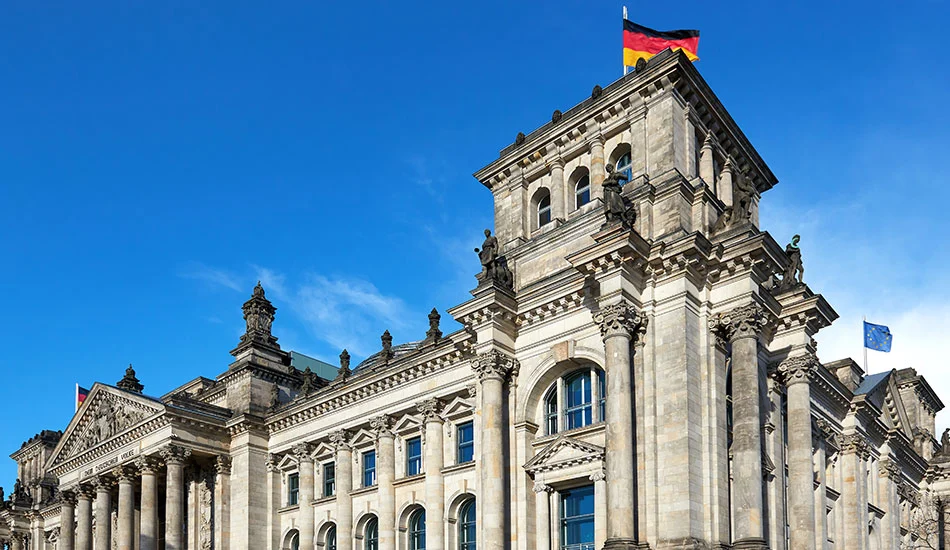
Berlin is the capital of Germany, the largest city, and the seat of the government. Other main cities are Hamburg, Munich and Cologne.
Political System
Germany is a federal parliamentary republic with a multi-party system. The federal government is composed of three branches: the executive branch, the legislative branch, and the judicial branch. The executive branch is headed by the Federal President, who serves as the ceremonial head of state, and the Federal Chancellor, who serves as the head of government. The Chancellor is responsible for leading the government and implementing policies with the help of a cabinet of ministers.
The legislative branch is composed of two chambers: the Bundestag (Federal Parliament) and the Bundesrat (Federal Council). The Bundestag is the lower house and has 630 members who are elected through a mixed-member proportional system. The Bundesrat is the upper house and is composed of representatives from the 16 states of Germany. The judicial branch is independent and is responsible for interpreting and applying the law. It is composed of various courts, including the Federal Constitutional Court, which has the power to declare laws unconstitutional. Germany has a multi-party system, with several major parties that typically receive significant representation in the Bundestag.
Legal System
The legislative system of Germany has two chambers – the Bundestag (Federal Parliament) and the Bundesrat (Federal Council). The Bundestag is the lower house of the German parliament and is the primary legislative body. It is composed of 630 members who are elected through a mixed-member proportional system. This means that each voter has two votes: one for a local representative in their electoral district, and one for a political party.
Half of the seats in the Bundestag are filled by direct election of representatives from each of Germany’s 299 electoral districts, while the other half are filled by members elected from party lists based on the proportion of votes that each party receives.
The Bundestag is responsible for passing legislation, approving the budget, and overseeing the actions of the government. It is also responsible for electing the Chancellor, who is the head of government.
The Bundesrat is the upper house of the German parliament and is composed of representatives from the 16 states of Germany. The number of representatives from each state varies based on the state’s population. The Bundesrat has the power to approve or reject legislation passed by the Bundestag and to propose amendments to bills. In order for legislation to become law, it must be approved by both the Bundestag and the Bundesrat. In most cases, the Bundestag has the final say on legislation, but the Bundesrat can delay or block bills that affect the interests of the states.
Immigration procedure for expatriate employees
Permits to hire expatriate employees
Nationals of EU Member States can take advantage of unrestricted freedom of movement for workers and are not subject to any restrictions regarding work permits. The same applies to nationals of the EEA States Iceland, Norway, and Liechtenstein. Swiss nationals are equivalent to EEA nationals.
Nationals from countries that do not belong to the European Union (EU) or the European Economic Area (EEA) – so-called third country nationals – need a residence title.
There are several permits available for hiring expatriate employees, including:
1. EU Blue Card: This permit is for highly skilled non-EU citizens who have a university degree and a job offer with a minimum salary threshold. It allows them to live and work in Germany. The earning limit for applying for a Blue Card has been set at EUR 50,700 per year (2026).
2. Residence Permit for Employment Purposes: This permit is for non-EU citizens who have a job offer in Germany and meet certain criteria. It allows them to live and work in Germany for a specific period.
3. ICT Card: This permit is for intra-corporate transferees who are temporarily transferred to Germany from a non-EU country within the same company or group of companies.
4. Work Visa: This permit is for non-EU citizens who have a job offer in Germany but do not qualify for the EU Blue Card or other specific permits.
Each permit has its own requirements and application process. It’s important to carefully review the specific criteria for each permit before applying.
Access to the German labour market is determined by the provisions of the German Residence Act (AufenthG). For a residence for the purpose of gainful employment, approval by the Federal Employment Agency (BA) is always required. This approval can be obtained in an internal procedure from the German agency abroad in the country of origin (visa centre) or the responsible local immigration authority in Germany. The permit for taking up employment is awarded along with the residence title.
Effective 1 January 2026, Germany revised its salary thresholds for the EU Blue Card, the most common highly-skilled work/residence permit:
Standard EU Blue Card: Minimum gross annual salary is now €50,700.
Shortage occupations / key STEM roles: Lower threshold at €45,934.20.
These thresholds reflect the statutory formula based on social-security ceilings and are higher than the 2025 figures.
Procedure & Timeline
The procedure and timeline for obtaining work permits, including the Blue Card, typically involve the following steps:
1. Job Offer: The applicant must first receive a job offer from a German employer that meets certain criteria, such as salary level and qualifications. The earning limit for applying for a Blue Card has been set at EUR 50,700 per year in 2026.
2. Employer’s Application: The employer initiates the work permit application process by submitting a job offer letter and other required documents to the relevant authorities in Germany.
3. Approval from Federal Employment Agency (FEA): In some cases, the employer may need to obtain approval from the Federal Employment Agency (FEA) to hire a foreign worker. This step may require demonstrating that no suitable German or EU citizen is available for the position.
4. Application Submission: The applicant submits their visa application and supporting documents, including proof of employment, qualifications, and financial stability, to the German embassy or consulate in their home country.
5. Processing Time: The processing time for work permits can vary depending on the type of permit and the workload of the immigration authorities. Generally, it can take several weeks to several months to receive a decision.
6. Blue Card Application: If the applicant qualifies for the Blue Card scheme, they may apply for it concurrently with their work permit application. The Blue Card is typically issued to highly skilled workers and provides certain advantages, such as easier family reunification and quicker permanent residency options.
7. Residence Permit: Upon approval of the work permit or Blue Card, the applicant may need to apply for a residence permit upon arrival in Germany. This permit allows them to legally reside and work in the country for the duration specified in their employment contract.
It’s essential to note that the specific procedures and timelines may vary based on individual circumstances, such as the applicant’s nationality, occupation, and the region of Germany where they intend to work.
Timeline: National law foresees that the maximum processing time for issuing a Blue Card in Germany is 90 days.
Documents required for the application
To apply for a work permit in Germany, including a Blue Card, applicants typically need to submit the following documents:
1. Job Offer Letter: A formal offer of employment from a German employer, specifying details such as job title, salary, and duration of employment.
2. Valid Passport: A valid passport with a validity period that extends beyond the intended duration of stay in Germany.
3. Completed Application Form: The appropriate visa or work permit application form, which can be obtained from the German embassy or consulate in the applicant’s home country.
4. Educational Qualifications: Copies of educational certificates, such as degrees or diplomas, relevant to the job being offered. These documents may need to be translated into German by a certified translator.
5. Proof of Work Experience: Documentation of relevant work experience, such as employment certificates or letters of reference from previous employers.
6. Proof of Financial Means: Evidence that the applicant has sufficient financial means to support themselves during their stay in Germany, such as bank statements or a letter of financial support.
7. Health Insurance: Proof of health insurance coverage that meets the requirements of the German healthcare system.
8. Biometric Passport Photos: Recent passport-sized photographs that meet the specifications outlined by the German authorities.
9. Blue Card Specific Requirements: For Blue Card applications, additional documents may include proof of employment in a qualified occupation, such as a contract or binding job offer, and evidence that the applicant meets the salary threshold for Blue Card holders.
10. Additional Documents: Depending on the specific circumstances of the applicant and the nature of the job, additional documents may be required. These could include a criminal record certificate, medical examination reports, or other supporting documents.
It’s important to note that the exact requirements may vary depending on factors such as the applicant’s nationality, the type of work permit being applied for, and the policies of the German immigration authorities. Applicants should consult the website of the German embassy or consulate in their home country for specific guidance and instructions.
Costs
The costs associated with obtaining a work permit in Germany, including a Blue Card, can vary depending on various factors such as the type of permit, the applicant’s nationality, and any additional services required. Here is an overview of some common costs:
1. Application Fee: The application fee for a work permit or Blue Card in Germany typically ranges from €50 to €100. This fee may vary based on the type of permit and the applicant’s nationality.
2. Health Insurance: All residents in Germany, including foreign workers, are required to have health insurance. The cost of health insurance can vary depending on the provider, coverage options, and the applicant’s age and health status.
3. Biometric Passport Photos: Applicants are usually required to provide biometric passport photos as part of the application process. The cost of obtaining passport photos can vary depending on the location and the number of photos required.
4. Translation and Certification Costs: If any documents need to be translated into German or certified by a translator, there may be additional costs associated with these services.
5. Legal Fees: Some applicants choose to seek assistance from immigration lawyers or advisors to help navigate the application process. The cost of legal services can vary depending on the complexity of the case and the services provided.
6. Other Expenses: Depending on the specific circumstances of the applicant, there may be other expenses such as travel costs for attending interviews or appointments, accommodation expenses, and costs associated with obtaining any additional required documents.
It’s important for applicants to budget for these costs and to inquire about specific fees and expenses associated with their situation. Additionally, applicants should be aware that fees and requirements may change over time, so it’s advisable to consult the website of the German immigration authorities or seek guidance from a reputable source for the most up-to-date information.
Useful link: https://www.auswaertiges-amt.de/en/skilled-worker-immigration/2304796